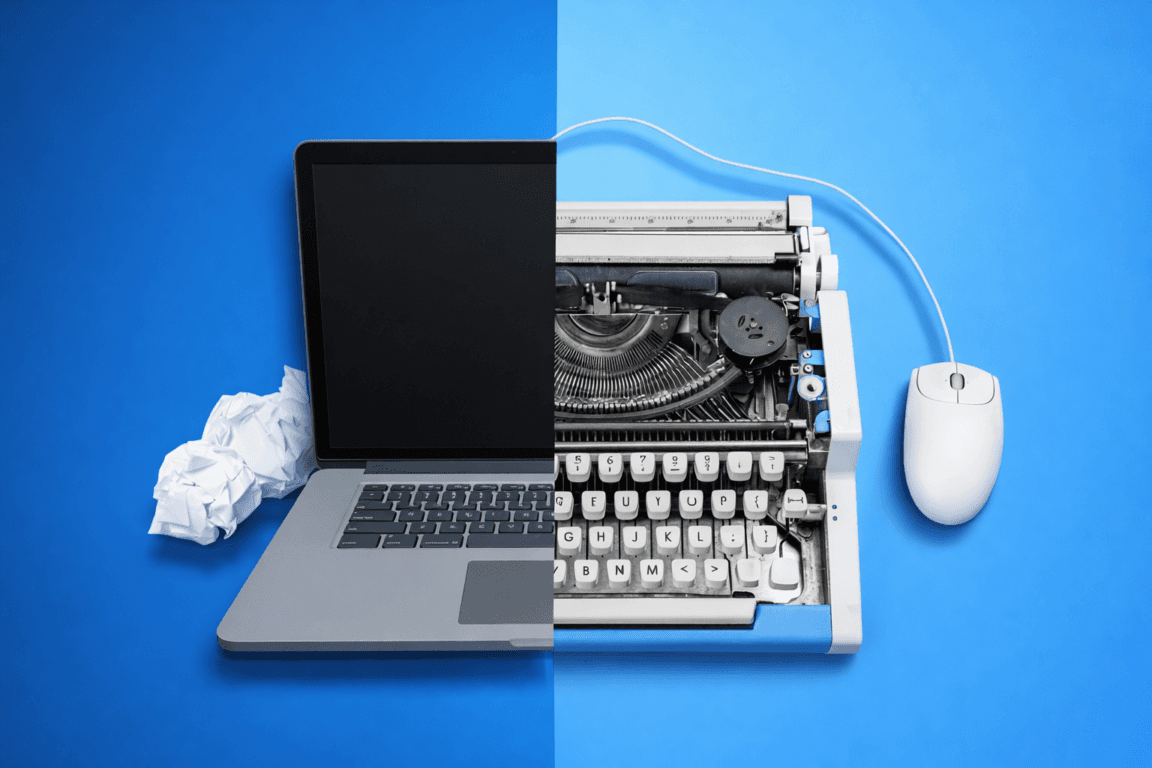
Depending on how long you've been around, you probably remember when the typewriter was the tool. No backspace. No undo. No cloud. Just ink, paper, and precision.
Computers were once a concept everyone understood would change everything. Today, connected systems run finance, healthcare, logistics, communication, defense, and marketing. You don't hear about typewriters anymore. That is the lens businesses should use when thinking about AI.
AI Is Not a Feature. It's a Shift.
AI is not another marketing tool, plugin, or buzzword. It is an infrastructure shift. Major technology companies have integrated AI into core products and workflows because they see where value and risk are moving.
When search-centric platforms face direct-answer AI systems, this is not incremental product improvement. It is defensive positioning and strategic reallocation of capital, infrastructure, and compute.
The Competitive Reality
Most businesses view competition emotionally: the local shop, the familiar rival, the company across town. Real competitive edges usually come from speed, efficiency, and operational leverage.
Uber built a software layer over transportation. DoorDash built a logistics layer over restaurants. Airbnb built a marketplace layer over lodging. Ease of use won, and friction lost.
AI is applying the same pattern, but inside operations. It compresses the timeline between idea, execution, and iteration.
The Real Risk Isn't AI. It's Acceleration.
The uncomfortable question is simple: what happens if your competitor achieves your next two years of growth in six months?
- Generate production-ready code
- Automate research and analysis
- Optimize campaigns at scale
- Create and test content variations quickly
- Identify internal inefficiencies and build tools to fix them
AI does not remove strategic thinking. It compresses time. That compression is where modern advantage is created.
The Noise Problem
Current discourse swings between extremes: "AI is replacing everything" and "AI is a bubble." Investment flows and headlines create noise. The operational question is more practical: are you actively using AI in measurable workflows?
AI Can Build. Humans Must Architect.
AI can code, design, and generate systems. Production environments still require engineering responsibility:
- Testing and validation
- Security review and oversight
- Strategic alignment with business goals
- Human judgment at critical decision points
The winning organizations are not blindly "turning on AI." They are aligning it with clear objectives, measurable KPIs, operating frameworks, and experienced leadership.
This Is a Maturity Curve
Early smartphones were clunky and fragmented before mature UX won. AI is in a similar rapid-iteration stage. Pioneers will overbuild. Opportunists will overpromise. Skeptics will under-adopt. Mature operators will implement with discipline.
How We View AI
We view AI the same way businesses once had to view computers: not as a trend, but as infrastructure. Preference is irrelevant. Competitive adoption is not.
If AI creates a 10% operational advantage, someone in your market will take it. If it shortens deployment cycles and improves execution quality, someone is already using it.
Final Thought
The shift from typewriters to computers was not about convenience. It was about inevitability. AI belongs in that same category.
The real question is not whether AI will change your market. It is how fast your competitors will use it to change their position.
References and Context
Relevant context supporting the themes discussed in this article: